Black and White God Holding the World in His Hands Clip Art
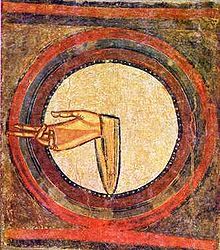

The Mitt of God, or Mitt Dei in Latin, also known as Dextera domini/dei (the "right mitt of God"), is a motif in Jewish and Christian fine art, peculiarly of the Late Antiquarian and Early Medieval periods, when delineation of Yahweh or God the Begetter as a full man figure was considered unacceptable. The mitt, sometimes including a portion of an arm, or ending nigh the wrist, is used to point the intervention in or approval of affairs on Globe by God, and sometimes as a subject in itself. It is an artistic metaphor that is generally not intended to indicate that a paw was physically present or seen at whatever subject depicted. The Hand is seen actualization from in a higher place in a fairly restricted number of narrative contexts, often in a blessing gesture (in Christian examples), but sometimes performing an action. In subsequently Christian works information technology tends to be replaced by a fully realized figure of God the Father, whose depiction had become adequate in Western Christianity, although not in Eastern Orthodox or Jewish art.[1] Though the mitt of God has traditionally been understood as a symbol for God's intervention or approving of human diplomacy, information technology is also possible that the hand of God reflects the anthropomorphic conceptions of the deity that may have persisted in tardily artifact.[2]
The largest grouping of Jewish imagery from the ancient world, the 3rd century synagogue at Dura-Europas, has the hand of God in five dissimilar scenes, including the Cede of Isaac,[3] and no doubtfulness this was one of the many iconographic features taken over past Christian fine art from what seems to have been a vigorous tradition of Jewish narrative art. Here and elsewhere it oft represents the bath Kol (literally "daughter of a vocalism") or voice of God,[a] a use also taken over into Christian fine art.
The manus may also relate to older traditions in various other religions in the Aboriginal About Eastward.[4] In the art of the Amarna period in Egypt nether Akhenaten, the rays of the Aten sun-disk stop in small hands to advise the bounty of the supreme deity. Like the hamsa amulet, the hand is sometimes shown alone on buildings, although information technology does not seem to have existed as a portable amulet-blazon object in Christian use. It is found from the fourth century on in the Catacombs of Rome, including paintings of Moses receiving the Law and the Cede of Isaac.[v]
There are numerous references to the hand, or arm, of God in the Hebrew Bible, most clearly metaphorical in the mode that remains electric current in modern English, but some capable of a literal interpretation.[i] They are usually distinguished from references to a placement at the right paw of God. After rabbinic literature also contains a number of references. There are 3 occasions in the gospels when the vocalisation of God is heard, and the hand oft represents this in visual art.[6] Gertrud Schiller distinguishes iii functions of the hand in Christian art: as symbol of either God'southward presence or the voice of God, or signifying God's acceptance of a cede.[seven]
In sacred texts and commentary [edit]

The Hand of God intervenes at the Cede of Isaac, Armenian, Akdamar, 10th century
Hebrew Bible [edit]
The paw of God, which encompasses God'due south arm and fingers also, is 1 of the most oft employed anthropomorphisms of the Hebrew Bible. References to the manus of God occur numerous times in the Pentateuch alone, particularly in regards to the unfolding narrative of the Israelites' exodus from Egypt (cf. Exodus 3:nineteen–twenty, Exodus 14: 3, 8, 31).[viii]
New Testament [edit]
There are no references to the paw of God as an active amanuensis or witness in the New Testament, though there are several to Jesus standing or sitting by the right hand of God in God's heavenly court,[9] a conventional term for the place of accolade beside a host or senior family fellow member. For example, when Stephen is filled with the "holy spirit" he looks to heaven and sees Jesus continuing by the right mitt of God (Acts 7:55). There are three occasions in the Gospels when the vocalization of God is heard, and the manus of God often represents this in visual art.[10]
Rabbinic literature [edit]
Anthropomorphic aggadot regarding the hand of God appear frequently in the corpus of rabbinic literature and aggrandize upon anthropomorphic biblical narratives.
Christian art [edit]
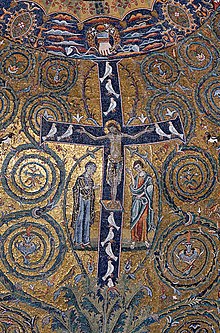
In Christian art, the manus of God has traditionally been understood as an artistic metaphor that is non intended to indicate that the deity was physically present or seen in whatever subject depicted. In the late antique and early medieval periods, the representation of the concentrated figure of God the Male parent would have been considered a grave violation of the Second Commandment.[11] According to conventional fine art historical interpretation, the representation of the hand of God in early Christian art thus developed as a necessary and symbolic compromise to the highly anti-anthropomorphic tenor of the Second Commandment, though anthropomorphic interpretations are certainly plausible.[12] In early Christian and Byzantine art, the manus of God is seen appearing from to a higher place in a adequately restricted number of narrative contexts, often in a approving gesture, but sometimes performing an action. Gertrud Schiller distinguishes three functions of the mitt in Christian art: as symbol of either God's presence or the vocalism of God, or signifying God'southward credence of a sacrifice.[13] In later Christian works it tends to exist replaced by a fully realized figure of God the Father, whose delineation had become acceptable in Western Christianity, although non in Eastern Orthodox or Jewish fine art.[1]
Iconography [edit]
The motif of the manus, with no body attached, provides a problem for the artist in how to terminate information technology. In Christian narrative images the mitt most often emerges from a small cloud, at or near the summit of the paradigm, only in iconic contexts it may announced cut off in the picture space, or spring from a border, or a victor's wreath (left). A cloud is mentioned as the source of the vocalism of God in the gospel accounts of the Transfiguration of Jesus (see below). Several of the examples in the Dura Europos synagogue (see beneath) bear witness a good part of the forearm also as the hand, which is not found in surviving Christian examples, and most show an open palm, sometimes with the fingers spread out. Later examples in Jewish fine art are closer in class to Christian styles.
In Christian art, the hand of God usually occupies the form of a approval gesture, if they are not performing an action, though some but show an open hand. The normal approving gesture is to point with the alphabetize and side by side finger, with the other fingers curled back and thumb relaxed. There is also a more than complicated Byzantine gesture that attempts to correspond the Greek letter chi, Christ's initial, which looks like a Latin letter of the alphabet "Ten". This is formed past crossing the thumb and little finger inside the palm, with simply the forefinger and adjacent 1 extended,[fourteen] or a variant of this.
Especially in Roman mosaics, but also in some German regal commissions, for example on the Lothair Cross, the mitt is clenched around a wreath that goes upwards, and behind which the arm then disappears, forming a tidy circular motif. Especially in these examples, the mitt may show the sleeve of a garment, sometimes of two layers, every bit at San Clemente, Rome. In blessing forms the manus frequently has a halo, which too may provide a convenient termination point. This may or may not be a cruciform halo, indicating the divinity, and specifically the Logos, or Pre-existing Christ (see below).

The hand is regularly seen in depictions of certain scenes, though it may occur on occasion in a much wider range.[15] In many scenes i or more angels, interim as the messengers of God, may appear instead of the mitt. A virtually unique mosaic delineation of the Ark of the Covenant (806) at Germigny-des-Prés, as well features the mitt of God.
In Christian art the manus will ofttimes really stand for the hand of God the Son, or the Logos; this is demonstrated when later depictions start to substitute for the Hand a small half-length portrait of Christ as Logos in a like circular frame. It is nearly always Christ in the East, but in the West God the Father will sometimes be shown in this way. However, in many contexts the person of the Trinity intended cannot be confirmed from the image alone, except in those images, like the Baptism of Christ, where Jesus the Incarnate Christ is also present, where the hand is clearly that of God the Father. Subsequently Eastern Orthodox images often place Hands equally the Logos with the usual monogram used in icons.[b]
Old Attestation imagery [edit]
- In the Vienna Genesis the hand appears above the Expulsion of Adam and Eve from Paradise. More often, God was shown in this story using the conventional depiction of Jesus representing the pre-existent Christ or Logos, who was seen every bit the Creator by Early Christian writers,[c] The story of Adam and Eve was the Quondam Testament bailiwick most often seen in Christian art that needed a pictorial representation of God. A well known modernistic variant of the traditional hand motif is a sculpture of 1898 by Auguste Rodin chosen the Hand of God, which shows a gigantic hand creating Adam and Eve.
- The Sacrifice of Isaac first appears in Christian art in 4th century depictions from the Roman catacombs and sarcophagi, besides as pieces like a fragment from a marble table from Republic of cyprus.[sixteen] Abraham is restrained by the manus, which in the Sarcophagus of Junius Bassus grasped his pocketknife mitt, as the affections ofttimes does in other depictions.[d] Nevertheless the angel mentioned in the biblical text is more usual, and often included besides. The use of the manus in this scene, at least in Christian art, indicates God's acceptance of the sacrifice, as well as his intervention to change it.
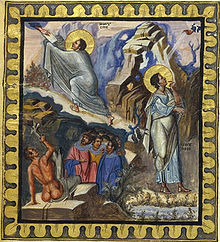
- Some depictions have the manus passing Moses the Tablets of the Police, found in the Roman catacombs, various Bibles (see gallery), the Paris Psalter, and in mosaic in the Basilica of San Vitale, Ravenna.[17]
- The prophet Ezekiel (2:ix–10) received his prophecy by hand: "And so I looked, and I saw a manus stretched out to me. In information technology was a whorl, which he unrolled before me. On both sides of information technology were written words of complaining and mourning and woe"[18] and this and other moments from Ezekiel sometimes include the hand. In the Paris Psalter, Moses, Jonah and Isaiah are all shown blest by hands, from which rays of light come. Other prophets are sometimes as well shown with the mitt.
- In the Klosterneuburg Altar, Drogo Sacramentary (shown below) and San Vitale, Ravenna, Melchizedek is shown blest by it, in the final combined with Abel. This relates to the approval of his sacrifice mentioned in the biblical text, and possibly too to the hand's association with divinely ordained monarchy (meet below), as Melchizedek was both priest and rex co-ordinate to Genesis 14:18–20, and his appearance in fine art is often to evoke this likewise as his function as a blazon for Christ.
- The hand tin appear in other contexts; the Carolingian Utrecht Psalter atypically illustrates virtually all the Psalms, probably following an Antique model, and shows the hand in at least 27 of these images, despite also using a figure of Christ-as-God in the heavens fifty-fifty more frequently.[19]
- A mosaic in the Mausoleum of Galla Placidia in Ravenna shows the battle of Beth-horon with the Amorites (Joshua, 10:xi), where: "As they fled before State of israel on the road downwardly from Beth Horon to Azekah, the LORD hurled big hailstones downwardly on them from the sky, and more of them died from the hailstones than were killed by the swords of the Israelites" – with a large manus representing God.
- The story in Daniel v:one–31 of the writing on the wall is rarely depicted until the 17th century, when Rembrandt's well known version and others were produced.
-

Moses receives the Tablets, c. 840
-

New Testament imagery [edit]
- In depictions of the Life of Christ, the hand often appears at the Baptism of Christ representing the voice of God, to a higher place the dove representing the Holy Spirit, which is much more common, thus showing the whole Trinity equally present and active.[20] The hand never seems to appear without the pigeon, as the Holy Spirit every bit a dove is mentioned in the Gospel of Mark: "As soon equally Jesus was baptized, he went up out of the water. At that moment heaven was opened, and he saw the Spirit of God descending like a dove and lighting on him. And a vox from sky said, "This is my Son, whom I dearest; with him I am well pleased."[21] Both dove and hand are normally located centrally, pointing direct down at Jesus. The mitt is mostly found in Baptisms between the 6th (e.g. Rabbula Gospels) and 11th centuries.
- The manus is found in some Western and subsequently Armenian scenes of the Transfiguration of Jesus,[22] where again the Synoptic Gospels have the vocalisation of God speaking, this time from a deject.[23]
- The hand is sometimes seen in the Desperation in the Garden, though an angel is more mutual. This is the third and final occasion when the voice of God is mentioned in the gospels, this fourth dimension only in the Gospel of John (12:28). The primeval known example is in the St Augustine Gospels of c.600.[24]
- From Carolingian art until the Romanesque menstruum, the paw may appear above the elevation of the cross in the Crucifixion of Jesus, pointing straight down. Sometimes information technology holds a wreath over Christ's head, as on the rear of the Ottonian Lothair Cross at Aachen Cathedral. The hand represents divine approval, and specifically acceptance of his sacrifice,[25] and possibly also the storm mentioned in the gospels.
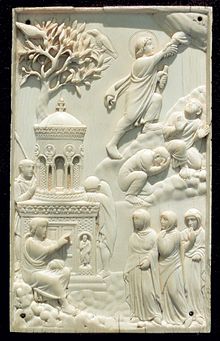
- The manus may be seen in the Ascent of Christ, sometimes, as in the Drogo Sacramentary, reaching down and clasping that of Christ, as though to pull him upward into the clouds. The ivory plaque at present in Munich (left) with such a depiction is possibly the earliest representation of the Rise to survive.
- In Eastern Orthodox icons of the Last Judgement, the hand often holds the scales in which souls are weighed (in the West Saint Michael typically does this). The hand may emerge from the Hetoimasia normally present, and is typically huge in size compared to the total figures nearby in the composition.
-

-

Hand with halo in 13th century stained glass of the Agony in the Garden
Divine blessing of rulers imagery [edit]
The hand often blesses rulers from above, particularly in Carolingian and Ottonian works, and coins. The hand may hold a wreath or crown over the ruler's head, or place it on the head. A posthumous money of Constantine the Corking (the "deification issue") had shown the hand reaching down to pull upwardly a veiled figure of Constantine in a quadriga, in a famously mixed message that combined pagan conventions, where an eagle drew deified emperors up to the heavens, with Christian iconography. From the late 4th century coins of Late Antiquarian rulers such every bit Arcadius (and his empress), Galla Placidia and others show them being crowned by it – it was in fact mostly used for empresses, and ofttimes only appears on bug from the Eastern Empire.[26] This theme is non so seen in Byzantine art until the late 10th century, when it appears in coins of John I Tzimisces (969–976), long after it was mutual in the West.[27] In later Byzantine miniatures figures the hand is often replaced by a full figure of Christ (in these examples much smaller than the Emperor) placing a crown on the head.[28]
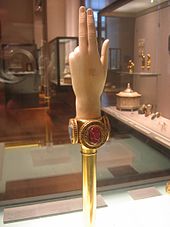
A like symbolism was represented by the "Main de Justice" ("Paw of Justice"), function of the traditional French Coronation Regalia, which was a sceptre in the form of a short gold rod surmounted by an ivory hand in the blessing gesture. The object now in the Louvre is a recreation, made for Napoleon or a restored Bourbon male monarch, of the original, which was destroyed in the French Revolution, although the original ivory manus has survived (now displayed separately). Engraved gems are used for an authentic medieval experience. Here the paw represents the justice-dispensing power of God as beingness literally in the hands of the king.
-

-
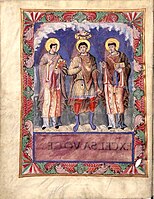
Charlemagne, flanked by ii popes, is crowned, manuscript of c. 870.
-
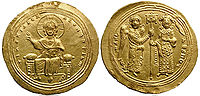
Byzantine gold histamenon coin of 1041/two. The emperor is crowned past the mitt.
Saints imagery [edit]

The paw can likewise be shown with images of saints, either actioning a miracle associated with a saint – in Catholic theology it is God who performs all miracles – or above an iconic scene. In the Bayeux Tapestry the hand appears over Westminster Abbey in the scene showing the funeral of Edward the Confessor. The hand sometimes appears (come across gallery) in scenes of the murder of martyrs similar St Thomas Becket, clearly indicating neither interest nor approval of the human activity, but approval of the saint. In the dedication miniature shown, the blessing hand seems pointed neither at Emperor Henry Three, nor St Gregory or the abbot, but at the re-create of Gregory's book – the same copy that contains this miniature. This looser usage of the motif reaches its peak in Romanesque art, where it occasionally appears in all sorts of contexts – indicating the "right" speaker in a miniature of a disputation, or as the simply decoration at the elevation of a monastic charter. A number of Anglo-Saxon coins of Edward the Elder and Æthelred the Unready has a large hand dominating their opposite sides, although religious symbols were rarely so prominent on Anglo-Saxon coins.[29]
Icons [edit]
In Eastern Orthodox icons the hand remained in use far longer than in the Western church, and is even so constitute in modern icons, usually emerging from round bands. Apart from the narrative scenes mentioned above it is peculiarly often found in icons of military saints, and in some Russian icons is identified by the usual inscription as belonging to Jesus Christ. In other versions of the same composition a small effigy of Christ of near the same size as the hand takes its place, which is also seen in many Western works from about grand onwards.
The earliest surviving icon of the Virgin Mary, of nigh 600 from Saint Catherine's Monastery, has an often overlooked manus, suggesting to Robin Cormack that the emphasis of the subject is on the Incarnation rather than a elementary Virgin and Child.[e] Another of the very few major Eastern works showing the Virgin from earlier the Byzantine iconoclasm, an alcove mosaic (lost in 1922) from Nicaea, also shows the hand above a standing Virgin. Few similar uses of the paw are seen in subsequently Virgins, though the iconographically adventurous Byzantine Chludov Psalter (9th century) has a small miniature showing the mitt and pigeon above a Virgin & Kid.[thirty] The mitt occasionally appears in Western Annunciations, fifty-fifty as late as Simone Martini in the 14th century, by which fourth dimension the dove, sometimes accompanied by a small image of God the Begetter, has become more common.[31]

Anonymous impress on the situation of the Netherlands in the 1570s, with three hands
Ravenna mosaics [edit]
The mitt appears at the meridian of a number of Late Antiquarian apse mosaics in Rome and Ravenna, above a variety of compositions that feature either Christ or the cantankerous,[f] some covered by the regular contexts mentioned above, but others not. The motif is so repeated in much later mosaics from the 12th century.
Belatedly Medieval and early Renaissance art [edit]
From the 14th century, and before in some contexts, full figures of God the Father became increasingly common in Western art, though still controversial and rare in the Orthodox world. Naturally such figures all accept hands, which use the blessing and other gestures in a variety of ways. It may exist noted that the most famous of all such uses, Michelangelo's creating hand of God in the Sistine Chapel ceiling, breaks clear of God'south encircling robe to a higher place the wrist, and is shown against a plain background in a mode reminiscent of many examples of the earlier motif.
The motif did not disappear in later iconography, and enjoyed a revival in the 15th century as the range of religious subjects profoundly expanded and depiction of God the Father became controversial again among Protestants. The prints of Daniel Hopfer and others make frequent use of the manus in a variety of contexts, and the personal emblem of John Calvin was a heart held in the Hand. Very gratis use of the motif is made in prints relating to the religious and political fall-out of the Reformation over the next two centuries, in prints on the Dutch Revolt for example. In a loftier Rococo setting at the Windberg Abbey, Lower Bavaria, the Hand of God holds scales in which a lily stem indicating Saint Catherine's purity outweighs the crown and sceptre of worldly pomp.
The like but substantially unrelated arm-reliquary was a popular form during the medieval flow when the hand was nigh used. Typically these are in precious metal, showing the mitt and most of the forearm, pointing upward erect from a flat base where the arm stopped. They contained relics, usually from that office of the trunk of the saint, and it was the saint's hand that was represented.
-
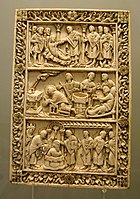
Miracle from the life of Saint Remy, c. 870, in the centre register. Notation the pigeon delivering the Sainte Ampoule at bottom.
-
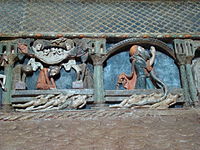
The mitt receives the souls of 3 martyrs born upward to sky by Angels. Ávila
Examples in late antique and medieval Jewish art [edit]
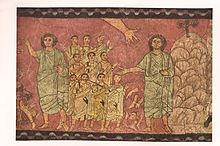
The hand of God appears in several examples from the small surviving trunk of figurative Jewish religious art. It is especially prominent in the wall paintings of the third-century Dura Europos synagogue, and besides seen in the nave mosaic of the sixth century Beth Alpha synagogue, and on a sixth-seventh century bimah screen found at the 4th-fifth century Susiya synagogue.[32]
Dura Europos synagogue [edit]
In the Dura Europos synagogue, the paw of God appears 10 times, in five out of the xx-nine biblically themed wall paintings including the Binding of Isaac, Moses and the Burning Bush, Exodus and Crossing of the Red Body of water, Elijah Reviving the Child of the Widow of Zarepheth, and Ezekiel in the Valley of Dry Bones.[33] In several examples the hand includes the forearm too.
Beth Alpha synagogue [edit]

In the Beth Alpha synagogue, the manus of God appears on the Binding of Isaac panel on the northern entryway of the synagogue'due south nave mosaic floor.[34] The hand of God appearing in the Beth Blastoff Bounden of Isaac mosaic panel is depicted every bit a disembodied hand emerging from a peppery ball of smoke, "directing the drama and its outcome" according to Meyer Schapiro.[35] The paw of God is positioned strategically in the upper center of the composition, directly above the ram that the angel of God instructs Abraham to sacrifice in identify of Isaac.
Susiya synagogue [edit]
In the Susiya synagogue, the paw of God appears on the defaced remains of a marble bimah screen that mayhap once illustrated a biblical scene such as Moses Receiving the Law or the Binding of Isaac.[36] Though the hand was subjected to intense iconoclastic hacking, the iconoclasts left some vestiges of the thumb and the receding fingers intact.[37] A thumbnail has been carved into the thumb. Foerster asserts that the paw of God originally held a Torah gyre, identifying the small piece of raised marble located between the thumb and fingers as a Torah scroll.[38]

Birds' Head Haggadah [edit]
The paw of God appears in the early 14th-century Haggadah, the Birds' Caput Haggadah, produced in Germany.[39] Two easily of God appear underneath the text of the Dayenu vocal, dispensing the manna from sky. The Birds' Head Haggadah is a particularly important visual source from the medieval catamenia, equally information technology is the earliest surviving example of a medieval illuminated Hebrew Haggadah.
Encounter also [edit]
- Hand of God – other uses
- God the Father in Western art
- Finger of God (Biblical phrase)
- Sabazios
- Human action of God
Notes [edit]
- Footnotes
- ^ A thing disputed by some scholars
- ^ For case in this icon, as compared to this 1, which shows the Mitt replaced with a Christ/Logos.
- ^ The account in Genesis naturally credits the Creation to the single figure of God, in Christian terms, God the Father. However the first person plural in Genesis 1:26 "And God said, Let us brand man in our image, after our likeness", and New Testament references to Christ as creator (John 1:3, Colossians i:15) led Early Christian writers to acquaintance the Creation with the Logos.
- ^ Though both paw and knife are at present missing, with only a wrist stump now remaining.
- ^ Run across also the apse mosaic of the Euphrasian Basilica, from about the 550s, which has a very similar composition.
- ^ 1 previously at Santi Cosma eastward Damiano (for example, see Dodwell, p. v), seems now to have been restored away. Others are in Santa Cecilia in Trastevere, Santa Prassede, and others illustrated hither.
- Citations
- ^ a b c "Anthropomorphism", Jewish Virtual Library, especially the section on Jewish fine art almost the end.
- ^ Bar Ilan, 321–35; Roth, 191; C. W. Griffith and David Paulsen, 97–118; Jensen, 120–21; Paulsen, 105–16; Jill Joshowitz, The Hand of God:The Anthropomorphic God of Late Antique Judaism: Archaeological and Textual Perspectives, (B.A. thesis, Yeshiva Academy, 2013).
- ^ Hachlili, pp. 144–145
- ^ Summarized past Hachlili, 145
- ^ Hachlili, 146
- ^ "in Ravenna and in Western art from the 9th until the eleventh centuries" according to Schiller I, 149, although Western examples of the hand in depictions of these occasions extend well earlier and after these dates.
- ^ Schiller, Two 674 (Index headings)
- ^ For an overview of scholarship on anthropomorphism in biblical and rabbinic Judaism see Meir Bar Ilan, "The Paw of God: A Chapter in Rabbinic Anthropomorphism", in Rashi 1040–1990 Hommage a Ephraim East. Urbach ed. Gabrielle Sed Rajna. (1993): 321–35; Edmond Cherbonnier, "The Logic of Biblical Anthropomorphism", Harvard Theological Review 55.iii (1962): 187–206; Alon Goshen Gottstein, "The Body every bit Image of God In Rabbinic Literature", Harvard Theological Review 87.ii (1994): 171–95; Jacob Neusner, The Incarnation of God (Philadelphia: Fortress, 1988); Morton Smith, "On the Shape of God and Humanity of Gentiles", in Religion in Artifact ed. Jacob Neusner (Leiden: Brill, 1968), 315–26; David Stern, "Imitatio Hominis: Anthropomorphism and the Character(s) of God in Rabbinic Literature", Prooftexts 12.2 (1992): 151– 74.
- ^ Marker 16:19, Luke 22:69, Matthew 22:44 and 26:64, Acts two:34 and 7:55, one Peter 3:22
- ^ "in Ravenna and in Western art from the 9th until the eleventh centuries" co-ordinate to Schiller I, 149, although Western examples of the hand in depictions of these occasions extend well before and after these dates.
- ^ Linda and Peter Murray, "Trinity", in The Oxford Companion to Christian Art and Architecture (Oxford: Oxford University Press, 1998), 544.
- ^ C. W. Griffith and David Paulsen, "Augustine and the Corporeality of God", Harvard Theological Review 95.1 (2002): 97–118; Robin Jensen, Face to Face: Portraits of the Divine in Early Christianity (Minneapolis: Fortress, 2005), 120–21; David Paulsen, "Early on Christian Belief in a Corporeal Deity: Origen and Augustine as Reluctant Witnesses", Harvard Theological Review, 83.2 (1990): 105–16.
- ^ Schiller, Ii 674 (Index headings)
- ^ Didron, I, 201–3
- ^ See index of Schiller Ii under "Manus of God"
- ^ Weitzmann, Kurt, ed., Age of spirituality : late antique and early on Christian art, 3rd to seventh century, no. 380, 1979, Metropolitan Museum of Art, New York, ISBN 978-0-87099-179-0; full text available online from The Metropolitan Museum of Art Libraries.
- ^ Noga-Banai, Galit. The Trophies of the Martyrs: An Art Historical Study of Early on Christian Argent Reliquaries, Oxford University Printing, 2008, ISBN 0-19-921774-two, ISBN 978-0-19-921774-eight Google books
- ^ Ezekiel Ch. 2, NIV
- ^ Utrecht Psalter online – for hands see Psalms 2,v,fourteen,21–23,26,29,40,42,48,53–55,63,77,83,86,105,111,118,123–125,132,136–vii.
- ^ Grabar, 115 & Schiller, I pp. 134 & 137–9
- ^ Mark 3:16–17 NIV; all three Synoptic Gospels take the vox.
- ^ Schiller, I pp. 148–151. Come across besides Mathews, p. 96
- ^ Bible texts and commentaries
- ^ Schiller, II, 49
- ^ Schiller, II, 107–108 and passim
- ^ Catalogue of late Roman coins in the Dumbarton Oaks Drove and in the Whittemore Collection: from Arcadius and Honorius to the accession of Anastasius, Philip Grierson, Melinda Mays, Dumbarton Oaks, 1992, ISBN 0-88402-193-ix, ISBN 978-0-88402-193-3 Google books gives a full account of Late Antique usage. See as well David Sear coin glossary
- ^ Zach Margulies, "Christian Themes in Byzantine Coinage, 307 - 1204"
- ^ Examples here and here
- ^ Casson, 274 & illustration on 269
- ^ Schiller, I, p. vii & fig. 3
- ^ Schiller, I pp. 43,44,45,47, figs 82, 97, 108
- ^ Cecil Roth, "Anthropomorphism, Jewish Fine art", in Encyclopedia Judaica, ed. Fred Skolnik and Michael Berenbaum (Thomson Gale; Detroit : Macmillan Reference Us, 2007), 191
- ^ Kraeling, 57
- ^ Eleazar Sukenik, The Synagogue at Beth Alpha, forty.
- ^ Shapiro, xxx
- ^ Steven Werlin, "Khirbet Susiya" in The Late Ancient Synagogues of Southern Palestine, (Ph.D. diss., University of Northward Carolina Chapel Loma, 2012): 525.
- ^ Steven Fine, "Iconoclasm: Who Defeated this Jewish Fine art", Bible Review (2000): 32-43; Robert Shick, "Iconoclasm", in The Christian Communities of Palestine from Byzantine to Islamic Rule: A Historical and Archaeological Study (Darwin Press Inc.: Princeton, North.J.), 213.
- ^ Foerster, Decorated Marble Chancel Screens, 1820.
- ^ "Bird's Head Haggadah", Israel Museum Digital Catalogue, Israel Museum, Jerusalem http://www.english.imjnet.org.il/popup?c0=13475 Archived 2015-05-27 at the Wayback Car.
References [edit]
- Bar Ilan, Meir. "The Hand of God: A Affiliate in Rabbinic Anthropomorphism", in Rashi 1040–1990 Hommage a Ephraim E. Urbach ed. Gabrielle Sed Rajna. (1993): 321–35.
- Beckwith, John. Early on Medieval Fine art: Carolingian, Ottonian, Romanesque, Thames & Hudson, 1964 (rev. 1969), ISBN 0-500-20019-10
- Cahn, Walter, Romanesque Bible Illumination, Ithaca, New York: Cornell University Press, 1982, ISBN 0-8014-1446-6
- Didron, Adolphe Napoléon, "Christian Iconography: Or, The History of Christian Art in the Heart Ages", translated by Ellen J. Millington, 1851, H. G. Bohn, Digitized for Google Books.
- Casson, Stanley, "Byzantium and Anglo-Saxon Sculpture-I", The Burlington Magazine, Vol. 61, No. 357 (December., 1932), pp. 265–269+272-274, JSTOR
- Cherbonnier, Edmond. "The Logic of Biblical Anthropomorphism", Harvard Theological Review 55.3 (1962): 187–206.
- Cohen, Martin Samuel. Shi'ur Qomah: Texts and Recensions (Tübingen : J. C. B. Mohr (Paul Siebeck), 1985.
- Dodwell, C. R.; The Pictorial arts of the Due west, 800–1200, 1993, Yale UP, ISBN 0-300-06493-4
- Foerster, Gideon. "Busy Marble Chancel Screens in Sixth Century Synagogues in Palestine and their Relation to Christian Fine art and Architecture", in Actes du XIe congrès international d'archéologie chrétienne vol. I–II (Lyon, Vienne, Grenoble, Genève, August 21–28 September 1986; Rome: École Française de Rome, 1989): 1809–1820.
- Goshen Gottstein, Alon. "The Body as Image of God In Rabbinic Literature", Harvard Theological Review 87.2 (1994): 171–195.
- Grabar, André; Christian iconography: a written report of its origins, Taylor & Francis, 1968, ISBN 0-7100-0605-5, ISBN 978-0-7100-0605-9 Google books
- Griffith, C. W. and David Paulsen. "Augustine and the Corporeality of God", Harvard Theological Review 95.ane (2002): 97-118.
- Hachlili, Rachel. Ancient Jewish Fine art and Archeology in the Diaspora, Part 1, BRILL, 1998, ISBN 90-04-10878-v, ISBN 978-xc-04-10878-3, Google books
- Kessler, Edward in Sawyer, John F. A. The Blackwell companion to the Bible and culture, Wiley-Blackwell, 2006, ISBN 1-4051-0136-9, ISBN 978-1-4051-0136-3 Google books
- Kraeling, Carl H., The Synagogue: The Excavations of Dura Europos, Final Report Eight (New York: Ktav Publishing House, 1979)
- Jensen, Robin. Face to Face: Portraits of the Divine in Early Christianity (Minneapolis: Fortress, 2005).
- Kraeling, Carl. The Synagogue: The Excavations of Dura Europos, Terminal Report VIII, (New York: Ktav Publishing House, 1979).
- Lieber, Laura S. Yannai on Genesis: An Invitation to Piyyut (Cincinnati: Hebrew Spousal relationship College Press, 2010).
- Mathews, Thomas F. & Sanjian, Avedis Krikor. Armenian gospel iconography: the tradition of the Glajor Gospel, Volume 29 of Dumbarton Oaks studies, Dumbarton Oaks, 1991, ISBN 0-88402-183-i, ISBN 978-0-88402-183-four.
- Murray, Linda and Peter. "Trinity", in The Oxford Companion to Christian Fine art and Architecture (Oxford: Oxford Academy Press, 1998).
- Neusner, Jacob. The Incarnation of God (Philadelphia: Fortress, 1988).
- Paulsen, David. "Early Christian Belief in a Corporeal Deity: Origen and Augustine as Reluctant Witnesses", Harvard Theological Review, 83.2 (1990): 105–16.
- Rabinowitz, Zvi Meir. Mahzor Yannai (Jerusalem: Bialik Institute, 1985).
- Roth, Cecil. "Anthropomorphism, Jewish Art", in Encyclopedia Judaica, ed. Fred Skolnik and Michael Berenbaum (Thomson Gale; Detroit : Macmillan Reference Usa, 2007), 191.
- Schapiro, Meyer, Selected Papers, volume 3, Belatedly Antique, Early Christian and Mediaeval Art, 1980, Chatto & Windus, London, ISBN 0-7011-2514-4
- Schiller, Gertrud, Iconography of Christian Fine art, Vols. I & II, 1971/1972 (English trans from German), Lund Humphries, London, ISBN 0-85331-270-2 I & ISBN 0-85331-324-five Ii
- Stern, David. "Imitatio Hominis: Anthropomorphism and the Character(south) of God in Rabbinic Literature", Prooftexts 12.ii (1992): 151–174.
- Sukenik, Eleazar. The Ancient Synagogue at Beth Alpha: an account of the excavations conducted on behalf of the Hebrew Academy, Jerusalem (Piscataway, N.J.: Georgias Press, 2007).
Source: https://en.wikipedia.org/wiki/Hand_of_God_(art)
0 Response to "Black and White God Holding the World in His Hands Clip Art"
Post a Comment