Wont Get Fooled Again Isolated Synth With Click
© Alexandr Maksimenko/RIA Novosti
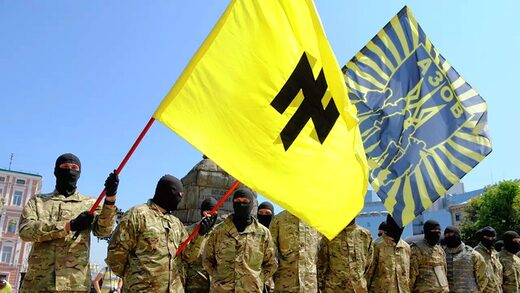
Azov battalion soldiers take an adjuration of allegiance to Ukraine in Kiev's Sophia Foursquare before being sent to the Donbass region
French President Emmanuel Macron claimed in his Wednesday address to the nation that Russian federation's special operation to demilitarise and "de-Nazify" Ukraine is "not a fight against Nazism", thus joining the chorus of political leaders and media outlets in the West who downplay or altogether deny the problem of Ukrainian ultra-nationalism.
Ukraine's ultra-nationalist and neo-Nazi battalions made headlines after the 2014 Feb coup d'etat in the country only to exist largely overlooked and downplayed in the ensuing years past the mainstream media.
"Far-correct, anti-Semitic, anti-Russian, and openly fascist groups accept existed and do exist equally a blight on modernistic Ukraine", CNN wrote in March 2014. It quoted a 2012 European Parliament resolution raising 18 points of business over policies embedded in the laws of the nation's parliament, and denounced "the rising nationalistic sentiment in Ukraine".
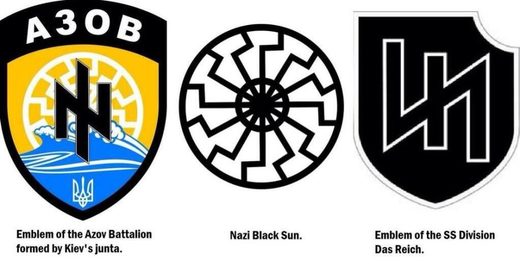
CNN admitted that Ukraine's ultra-nationalist parties and groups, including Svoboda and the Right Sector ultra-nationalists, played a significant part in the 2014 regime change in Kiev and later assumed positions in the National Security and Defence Council, the office of the Prosecutor General, and the ministries of ecology and agriculture of the interim regime.
Shortly after the coup, Ukraine saw the formation of volunteer nationalist battalions that carried out attacks against the breakaway Donbass republics and terrorised Eastern Ukrainian civilians. One of them, Azov, was led by Andriy Biletsky, former leader of the Kharkov branch of "the Stepan Bandera All-Ukrainian Arrangement 'Tryzub'" and co-founder of the ultra-nationalist movement, the Social-National Associates.
Biletsky was quoted as saying in 2010 that Ukraine'southward mission was to "pb the white races of the world in a final crusade...against Semite-led Untermenschen [subhumans]". He was a member of the post-coup Ukrainian Parliament betwixt 2014 and 2019. Azov formally joined the Ukrainian National Guard in 2014.
The Azov regiment, that still proudly wears the neo-Nazi Wolfsangel insignia, is notorious for attacking and displacing residents in eastern Ukraine, looting civilian holding, likewise equally raping and torturing detainees in Donbass, co-ordinate to a 2016 United nations report by the High Commissioner for Human Rights (OCHA).
Ukrainian nationalist organisations and political movements have been disseminating their ideology amidst young people with Kiev'south bankroll and funding. In 2020, the Ukrainian government allocated money for nationalist projects, including the "Cyborg Igor Branovitsky Charity Run", "Immature Banderite Course", "Banderstadt Festival of Ukrainian Spirit", etc. As the Ukrainian outlet STRANA.ua noted in 2020, the nationalist projects were due to receive 8 million hryvnia ($266,416) which is almost half of all the funds allocated by the Ukrainian government for children'due south and youth organisations.
The ministry's 2020 list also included the project "Unconquered" - named in honour of Yaroslav Robert Melnik, a regional leader of the Organisation of Ukrainian Nationalists (OUN) of the Carpathian region and a "major political educator" of the Ukrainian Insurgent Regular army (UPA)*. Both OUN and UPA are infamous for collaborating with Nazi Germany and conducting the ethnic cleansing of Jews, Russians, Roma, and Poles in the Nazi-occupied territories of Ukraine during WWII.
© AP Photograph / Alexander Zemlianichenko
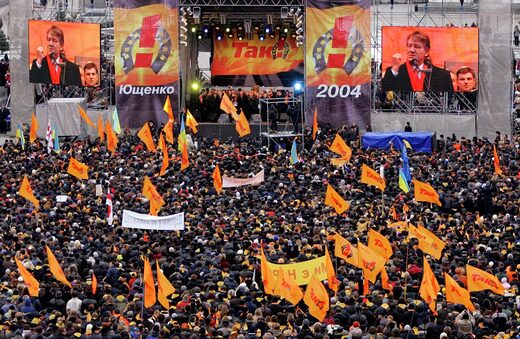
Opposition leader Viktor Yushchenko addresses a crowd in the central Independence Square in Ukraine'south capital Kiev, Monday, November.22, 2004
Subsequently the western-backed Orange Revolution, President Viktor Yushchenko altered the Ukrainian school curriculum to glorify both OUN and UPA and granted the titles of Hero of Ukraine to OUN-UPA leaders Roman Shukhevych and Stepan Bandera in 2007 and 2010, respectively.
While in May 2011, the Supreme Administrative Courtroom of Ukraine reversed Yushchenko'due south orders, President Petro Poroshenko gave OUN and UPA the status of "fighters for the independence" of Ukraine in 2015. As of today, several hundred monuments and statues take been erected and streets named later on erstwhile Nazi collaborators in Ukraine.
On 16 Dec 2021, the UN General Assembly discussed a resolution that called to combat the glorification of Nazism, neo-Nazism, and other practices that fuel racism and xenophobia. The only two countries that voted against it were the U.s. and Ukraine.
© Miroslav Luzetsky
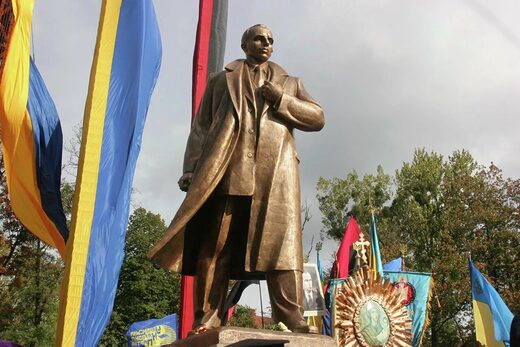
Unveiling a monument to Stepan Bandera, the leader of the Organisation of Ukrainian Nationalists, in Lviv.
OUN-UPA and Their Heirs
"Founded in 1929, the Organisation of Ukrainian Nationalists became the dominant political move of the Ukrainian far right. It was formed out of a number of radical nationalist and fascist groups and was, initially, led by war veterans, frustrated by their failure to plant a Ukrainian state in 1917-1920", wrote Per Anders Rudling, a Swedish-American historian and associate professor at the Section of History at Lund Academy in a 2011 study "The OUN, the UPA, and the Holocaust: A Written report in the Manufacturing of Historical Myths".
According to Rudling, there is no doubtfulness that OUN was a "fascist" system from its inception. The thought of racial purity was a leitmotif of OUN'southward ideology. The Ukrainian nationalist printing regularly carried anti-Semitic articles since the 1930s. After the Nazi occupation of Ukraine in 1941, OUN teamed upwards with them and went on an ethnic cleansing spree in the occupied territories."
The Nachtigall Battalion, consisting almost exclusively of OUN(b) activists serving in German language uniforms under Shukhevych's control, carried out mass shootings of Jews near Vinnytsia in July 1941", wrote Rudling. "At least 58 pogroms are documented in western Ukrainian cities, the estimated number of victims of which range between 13,000 and 35,000".
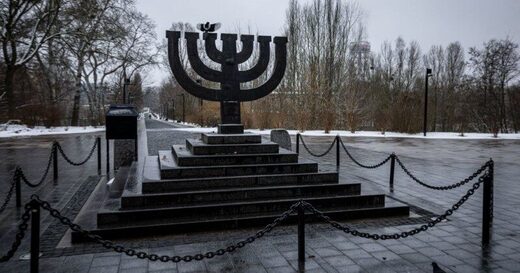
On 29-30 September 1941, Nazi forces and their Ukrainian collaborators executed nearly 34,000 Jews in Babi Yar, a ravine in the Ukrainian capital Kiev.
© Dimitar Dilkoff/AFP
A view of the Babyn (Babi) Yar Holocaust Memorial Center in Kyiv on March 2, 2022
From 1943 and until the inflow of the Soviet Regular army, OUN - and its military wing, UPA - had carried out massive ethnic cleansings of Poles in Volhynia and Galicia which claimed the lives of at least 88,700 people, including children, women, and the elderly.
"The murderers used primarily farm tools - scythes, knives, and pitchforks. Orthodox priests blest such weapons in their churches. The bodies were often badly mutilated...in order to dehumanise the victim and strike terror", noted the historian.
According to Rudling, the near vocal abet of this bloodbath was Mykola Lebed, then-interim leader of the OUN. Remarkably, information technology was Lebed who established contacts with the American intelligence services in 1945 from his exile in Rome, the historian wrote. Despite describing him as "a well-known sadist and collaborator of the Germans", the CIA and the The states State Section sponsored Lebed'southward 1949 immigration into the The states and shielded him from prosecution, according to Rudling.
After the defeat of Nazi Federal republic of germany in 1945, members of OUN and their paramilitary UPA units joined strange subversive groups, propaganda outlets, and intelligence agencies to fight against the USSR during the Common cold War.
In 1956, the CIA incorporated a prepare of networks under Lebed'south leadership and created the non-profit Prolog (Prologue) Research and Publishing Association, whose goal was to publish anti-communist propaganda, including radio broadcasts, newspapers, and books. During the Cold State of war, Ukrainian diasporas and OUN-UPA veterans were decorated whitewashing the organisation's crimes, the author pointed out. They created historic forgeries and myths about the OUN and UPA being pluralistic and inclusive organisations which rescued Jews during the Holocaust and fought shoulder to shoulder against Hitler and Stalin. After the collapse of the USSR, these narratives started filling the gap left by Soviet ideology in a new Ukrainian state.
"Different many other former Soviet republics, the Ukrainian government did not need to develop new national myths from scratch, but imported gear up concepts developed in the Ukrainian diaspora", wrote Rudling.
The trouble, withal, is that despite the manipulations of history, the fascist roots of Ukrainian radical nationalism never went away, according to the historian. The ideological heirs of the OUN-UPA got their first risk to receive government recognition under Viktor Yushchenko and and so, after the four-yr presidency of Viktor Yanukovich they returned to the stage to hijack even more power and penetrate the fabric of Ukrainian society.
*The Ukrainian Insurgent Army (UPA*) is an extremist organisation banned in Russia since 2014.
Source: https://www.sott.net/article/465179-Why-is-the-West-silent-about-Ukrainian-neo-Nazi-movements-Azov-Battalion-the-Bandera-legacy
0 Response to "Wont Get Fooled Again Isolated Synth With Click"
Post a Comment